
The real estate industry doesn’t have a software shortage. It has a software direction problem.
There are 40+ transaction management platforms on the market. Almost none of them are built for the person actually doing the work.
Most transaction management software isn’t built for the person running the transaction. It’s built for the mega-brokerage. There’s a difference, and if you’re an independent TC, a solo agent, or a boutique broker, you already feel it.
SkySlope, Dotloop, the brokerage-mandated stack — these tools exist so that a managing broker can pull a compliance report. So that an audit trail exists. So that someone three levels above you can see a dashboard. The actual work of coordinating a transaction — chasing documents, tracking deadlines, sending the same email for the fourteenth time this week — that’s your problem. Their software was never designed to solve it.
That’s not a conspiracy. It’s just economics. When brokerages write the checks, software companies build for brokerages. Features get prioritized by who’s paying, not by who’s working. The person doing the work is an afterthought. A row in someone else’s spreadsheet.
If you’re reading this, you probably already rejected that system.
You left the mega-brokerage. Or you started your own TC business. Or you hung your license somewhere that lets you operate your way. You made the harder choice because you wanted control — over your schedule, your clients, your income, your future.
But independence came with a trade-off nobody warned you about. When you walked away from the brokerage, you walked away from their infrastructure too. Their transaction management platform. Their document storage. Their systems — mediocre as they were, they existed.
So you improvised. Google Drive folders with naming conventions only you understand. A spreadsheet that tracks deadlines until it doesn’t. Maybe Trello, because someone in a Facebook group said it works. Maybe a competitor’s free tier that felt like a trap from day one.
It works at eight transactions. It cracks at fifteen. It breaks at twenty-five.
I call this the independence tax. The cost of choosing freedom is accepting worse tools. You traded a brokerage’s infrastructure for autonomy, and the industry punished you for it by offering nothing built for the way you actually work.
I built DocJacket to eliminate the independence tax.
Not to compete with SkySlope. Not to build a lighter version of Dotloop. Not to win a feature comparison chart against tools that were never designed for you in the first place.
DocJacket is AI transaction coordinator software built for one person: the operator. The person who opens their laptop at 6 AM and starts working through a list that nobody else manages. The person who tracks every deadline because if they don’t, nobody will. The person whose income is directly tied to how many transactions they can move through the pipeline without dropping a ball.
That’s a TC running 25 active files. That’s a solo agent managing their own deals. That’s a boutique broker who refuses to hire a compliance department just to use enterprise software.
If you need approval from an IT department to install your tools, this isn’t for you. If you’re shopping for a 500-seat contract, this isn’t for you. If you need a compliance dashboard so your managing broker can monitor your work — this definitely isn’t for you.
DocJacket is for the person who picks their own software because they’ve earned the right to.
Here’s what I believe about building software for operators:
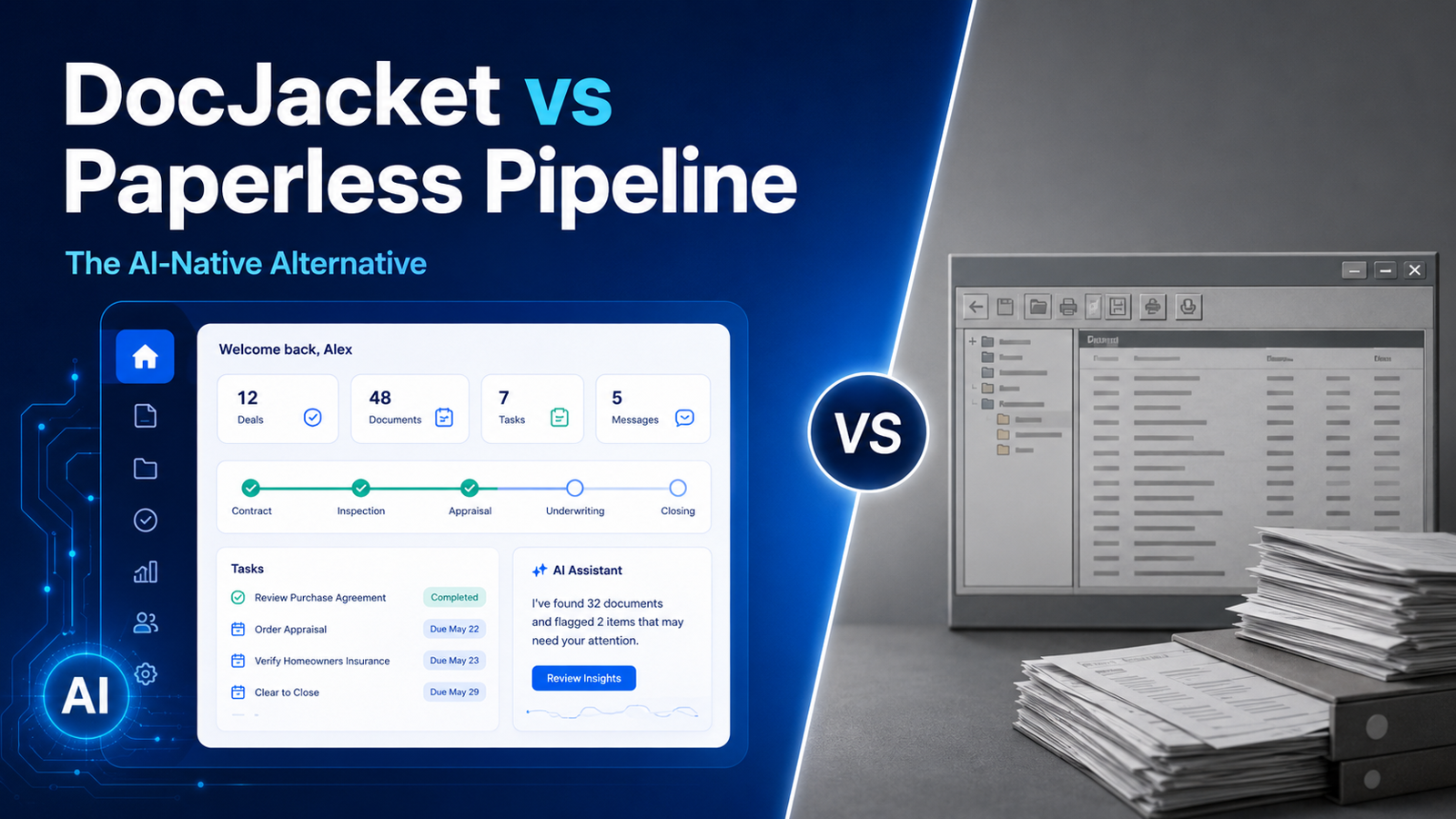
AI should do the work, not create more of it. Most “AI-powered” software dumps a wall of text at you and calls it automation. You end up reviewing AI outputs as a second job — fact-checking the model, fixing its mistakes, rewriting its drafts. The tool that was supposed to save you time has just shifted your work from doing the thing to babysitting a model doing the thing badly. DocJacket works differently. The AI reads contracts, flags dates, drafts communications, and sets up your workflow. Then it stops and waits for you. You review it, adjust what needs adjusting, approve it, and move on. The AI never sends an email without your sign-off. Never moves a deadline without your sign-off. Never closes a file without your sign-off.
AI preps. You approve. That’s not a limitation — it’s the whole point. You’re an operator. Operators don’t outsource judgment. They use tools that amplify their judgment. DocJacket is the amplifier, not the replacement.
Simple beats comprehensive. You don’t need 400 features. You need the 20 that match your actual workflow — and you need them to work perfectly. Every feature in DocJacket exists because an independent TC, agent, or broker told me they needed it, not because a product manager thought it looked good on a comparison chart.
Your software should cost what a tool costs, not what a platform costs. DocJacket is $29 a month. No “contact sales” button hiding the real price. No enterprise procurement process. The pricing is the positioning: this is a tool for an independent operator, priced like one.
Data portability is non-negotiable. Your transaction data is yours. Not mine, not a brokerage’s, yours. You should be able to leave any software — including DocJacket — and take everything with you. If a platform makes it hard to leave, that tells you everything about who they built it for.
I grew up watching my grandfather run his brokerage off dry-erase boards. I spent 21 years in Navy operations. Real estate transaction coordination is an operations problem — deadlines, dependencies, document handoffs, stakeholder communication — times twenty-five active files. The best systems are built for the person executing the mission, not the person reviewing it from headquarters. That’s exactly what DocJacket is.
I’m building DocJacket for the independent operators. The TCs, agents, and brokers who chose harder because they wanted better. You chose independence. Now choose better software.
DocJacket is AI transaction coordinator software for Independent TCs, Brokers & Agents. Start free — no credit card, no demo call, no sales process. Just upload a contract and see what happens. Try it.